

Senior nursing care facilities (also called skilled nursing facilities or SNFs) provide 24-hour medical supervision, nursing care, and rehabilitation for seniors with complex health needs. They differ from assisted living in that they employ licensed nurses and physicians on-site around the clock. About 70% of seniors will need some type of long-term care during their lifetime. Yet most families don't start researching options until a health crisis forces the conversation. If your parent has just been discharged from the hospital after a stroke, a fall, or major surgery, the discharge planner may hand you a list of senior nursing care facilities and expect a decision within 48 hours.
That is not a good situation to be in unprepared.
This guide explains what senior nursing care facilities are, how they compare to assisted living, what Medicare actually covers, and the concrete signs it is time to start looking. Whether you are planning ahead for yourself or searching for a parent, you will have clear answers.
What Is a Senior Nursing Care Facility?
A senior nursing care facility is a licensed residential setting that provides round-the-clock medical and personal care for seniors who cannot be safely managed at home or in an assisted living community. Licensed nurses are on-site 24 hours a day. Physicians supervise care plans. Therapists, including physical, occupational, and speech therapists, work with residents regularly.
These facilities go by several names: nursing homes, skilled nursing facilities (SNFs), convalescent homes, or long-term care facilities. The terms are largely interchangeable, though "skilled nursing facility" is the official Medicare designation.
Two types of stays are common:
- Short-term rehab:A senior recovers from hip replacement surgery, a stroke, or serious illness before returning home. This is the most common reason for SNF admission.
- Long-term care:A senior has ongoing medical needs, cognitive decline, or physical limitations that make independent living or assisted living unsafe on a permanent basis.
To learn more about how this level of care compares to other options, see Understand Your Care Options.
Senior Nursing Care Facility vs. Assisted Living: Key Differences
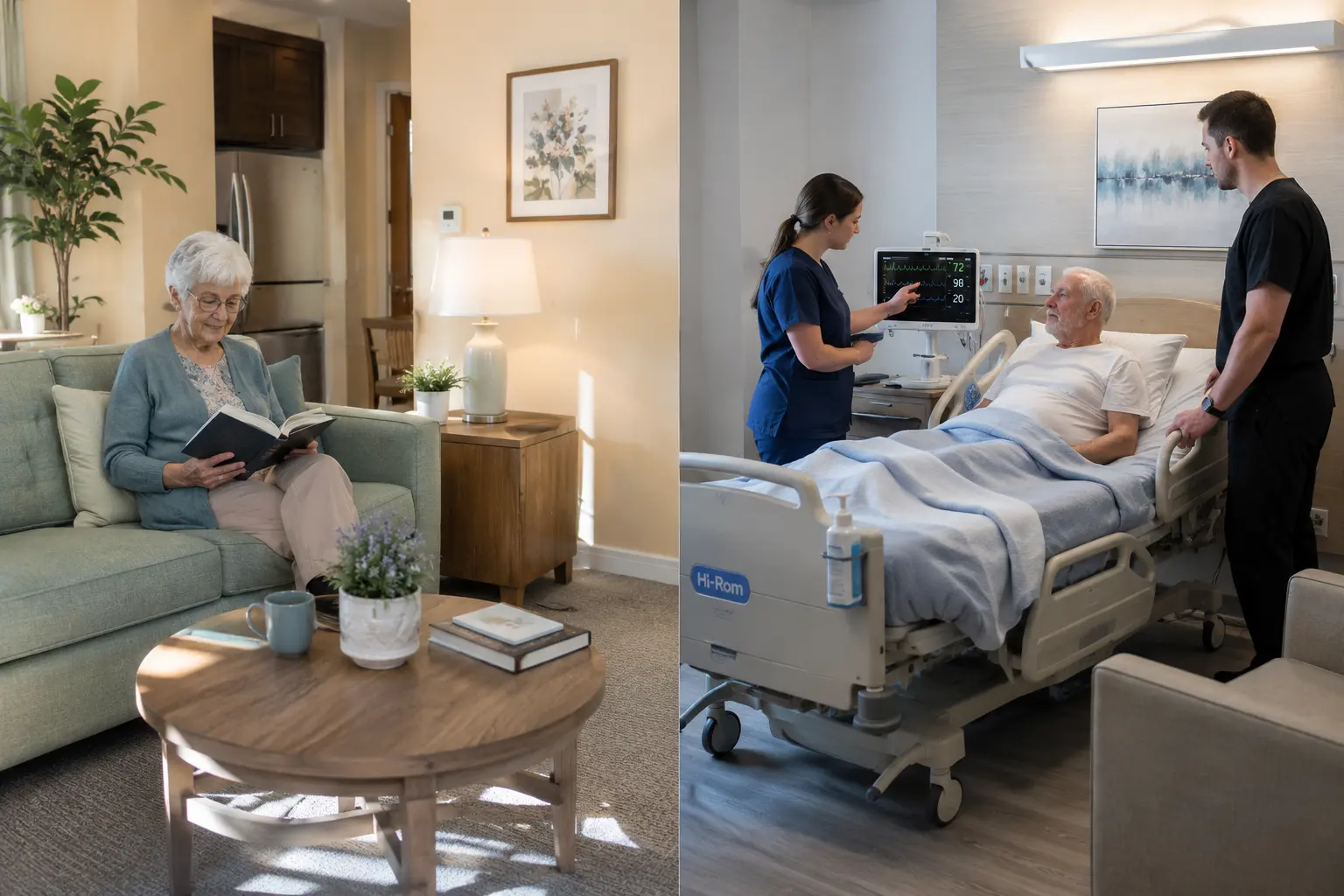
The main difference between a senior nursing care facility and assisted living is the level and intensity of medical care. Assisted living helps seniors with daily tasks like bathing, dressing, and meals. A skilled nursing facility goes much further: it provides clinical care that includes IV medications, wound management, tube feeding, respiratory therapy, and continuous medical monitoring.
Assisted living feels like a home. A skilled nursing facility feels more like a hospital step-down unit. That is not a criticism; it reflects what the care requires.
| Factor | Senior Nursing Care Facility | Assisted Living |
|---|---|---|
| Care Level | 24/7 medical + nursing care | Help with daily tasks, limited medical |
| Who It Suits | Complex chronic illness, post-surgery rehab | Seniors needing help with ADLs, not round-the-clock medical care |
| Staff On-Site | RNs, LPNs, physicians supervising 24/7 | Caregivers; nurse may be on-call only |
| Environment | Clinical; resembles a hospital step-down unit | Residential; home-like setting |
| Medicare Coverage | Up to 100 days (with qualifying hospital stay) | Does not cover room/board; covers some medical costs |
| Stay Duration | Short-term rehab or long-term permanent | Long-term permanent |
The right choice depends entirely on your loved one's medical complexity. If they are stable and need help with daily tasks but not constant clinical oversight, explore assisted living facilities near you first. If they have a chronic condition requiring regular skilled nursing interventions, an SNF is the right setting.
How Medicare Covers Skilled Nursing Facility Stays
Medicare Part A covers skilled nursing facility care only under specific conditions:
- You must have a qualifying inpatient hospital stay of at least 3 consecutive days.
- The care you need must be skilled (nursing, physical therapy, speech therapy, etc.).
- You must be admitted to a Medicare-certified SNF.
Medicaid does cover long-term nursing home care for those who qualify financially. Private long-term care insurance is another option worth reviewing before a crisis occurs.
Important limitation: Medicare's SNF coverage ends when a patient is no longer making measurable clinical progress, even if they still need some skilled care. Families are sometimes surprised by how quickly coverage can be reduced or terminated. Always confirm coverage status in writing with the facility.
Signs Your Parent May Need a Senior Nursing Care Facility
Consider a senior nursing care facility when assisted living or home care is no longer medically safe. Specific signs to watch for include:
- Frequent falls or recent serious injury requiring post-acute rehab
- A new diagnosis of a complex condition like congestive heart failure, COPD, or a major stroke requiring ongoing clinical management
- Need for wound care, IV medications, catheter management, or respiratory therapy
- Significant cognitive decline combined with physical care needs that exceed what home or assisted living staff can safely manage
- Recent hospital discharge with a care plan that requires skilled nursing follow-up
For example, if your father was hospitalized for a serious infection that required IV antibiotics, and he cannot yet manage at home but does not need to remain in the hospital, a short-term skilled nursing stay makes clear sense. He gets the clinical care he needs, works with a physical therapist to rebuild strength, and may return home in a matter of weeks.
If your mother has advanced Parkinson's disease with frequent falls and swallowing difficulties, a long-term placement in a nursing facility allows her to receive consistent neurological monitoring and specialized therapy in a safe environment.
Not every memory-related issue requires skilled nursing. If your loved one has early-to-mid-stage dementia and is otherwise physically stable, memory care facilities are often a better fit, with staff specifically trained for cognitive care needs.
How to Choose the Right Senior Nursing Care Facility

Not all nursing facilities are equal. Quality varies widely. Here is a practical checklist:
- Check staffing levels.A good rule of thumb is a resident-to-caregiver ratio no higher than 5:1 for attentive care. Ask specifically about RN hours per resident per day.
- Review state inspection reports.Medicare's Nursing Home Compare tool rates every certified facility on health inspections, staffing, and quality measures. Use it.
- Tour in person.Visit unannounced if possible. Observe whether staff interact warmly with residents, whether hallways smell clean, and whether residents appear engaged and comfortable.
- Ask about care planning.Your loved one's goals and preferences should shape the care plan, not just medical protocols. Good facilities involve families in care conferences.
- Understand the full cost structure.Ask for a written breakdown of base rate, included services, and what costs extra. Rate increases happen; ask how often and by how much.
For a broader look at what different levels of care offer, the Senior Care Resources hub on Geezer Guide walks through your options without any sales pressure.
You can also review the Type A vs Type B assisted living comparison if you are weighing a lower-acuity option before committing to a full nursing placement.
Frequently Asked Questions
What is the difference between a nursing home and a skilled nursing facility?
The terms are used interchangeably. "Skilled nursing facility" is the official Medicare term for a licensed nursing home that meets federal certification requirements. Both provide 24-hour medical and personal care, and both are subject to state and federal inspections.
Can a person go from assisted living to a nursing facility?
Yes, and this transition is common. A senior in assisted living who experiences a fall, a major health event, or progressive disease that requires clinical care may need to move to a skilled nursing facility. Some assisted living communities have arrangements with nearby SNFs to make this transition smoother.
Is a skilled nursing facility a good option for dementia patients?
It depends on the stage and the physical care needs present. In early to mid-stage dementia with no major physical complications, a dedicated memory care community is usually a better fit because the entire environment and staff are designed for cognitive care. In late-stage dementia with significant physical decline, a skilled nursing facility that offers a memory care unit may be the more appropriate setting.
What should I ask when touring a senior nursing care facility?
Key questions include: What is the RN staffing ratio per resident? How are care plans updated and how often are families included? What is the discharge process if a short-term stay is planned? How is the facility rated on Medicare's Nursing Home Compare tool? And importantly: what triggers a cost increase and how much notice will families receive?
Conclusion
Senior nursing care facilities serve a specific and important purpose. They are the right choice when medical complexity exceeds what assisted living or home care can safely handle. They are not the right choice if your loved one simply needs help with daily tasks and social engagement.
Know the costs going in, understand what Medicare actually covers, and do not skip the in-person tour. A good facility will welcome your questions, not rush you. A poor one will make you feel like a problem to manage.
Ready to compare skilled nursing facilities and other care options near you? Browse verified senior care listings on Geezer Guide and find the right fit without any sales pressure.